The Directors General of Military Operations of India and Pakistan firmed up the arrangement on stopping military actions on May 10 after four days of fierce offensives between the two sides that triggered fears of a wider conflict.

Russia has a "special mechanism" to confront any challenge arising out of the US slapping punitive measures against India for its procurement of Russian crude oil, Russian charge d'affaires Roman Babushkin said on Wednesday.

The post further read that "at a moment of heightened regional turbulence", President Trump "demonstrated great strategic foresight and stellar statesmanship through robust diplomatic engagement with both Islamabad and New Delhi," Dawn reported.
'Pakistan cannot sustain a war with India for more than four days. They are in such dire straits. At best they can sustain war for one week.'

The landmine exploded when the troops were patrolling in a forward area in Digwar sector this afternoon, the officials said.

China and Pakistan are in a tight strategic alliance. India must deal with them one at a time, but be prepared in case they decide to collude, points out Shekhar Gupta.
The casualties were reported hours before India and Pakistan agreed to end hostilities, which soared after the Indian Armed Forces hit terror launchpads in Pakistan and Pakistan-occupied Kashmir earlier this week in response to the Pahalgam attack.

'India for its survival has to change its doctrine from no first use to a pre-emptive attack in case of any hostile move by Pakistan,' recommends Colonel Anil A Athale (retd).
'There's something called deterrence by punishment.' 'That means you hit in a manner calculated to raise costs and consequences for Pakistan, so that the next time it attempts a Pahalgam-like attack, it has to think ten times.'

A series of blasts took place in Srinagar city as the security agencies brought down a drone that was seen hovering over Batwara area of the city, close to an army installation, officials said.

John Spencer, the chair of Urban Warfare Studies at US-based think-tank Modern War Institute, said India showcased its ability to strike any target in Pakistan "at will" and drew and enforced a "new red line" for cross-border terrorism under the operation that was launched early on May 7.
Can Imperial Japan be forgiven for what it did to Indian soldiers it was supposed to protect as PoWs?

The Cabinet Committee on Security (CCS) met on Wednesday under the chairmanship of Prime Minister Narendra Modi and firmed up the responses to the terror attack.
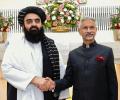
'Pakistan is uncomfortable with the Indian presence in Afghanistan. They want the Taliban to ensure that there is no Indian presence in Afghanistan.'
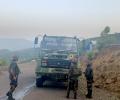
The attack took place near Shashidhar in the evening when the vehicles were moving towards Sanai Top in the district's Surankote area.

Two 'very smart' leaders of India and Pakistan decided to end last month's conflict that could have turned into a nuclear war, United States President Donald Trump said after holding a rare luncheon meeting with Pakistan army chief Field Marshal Asim Munir at the White House.
'One good outcome of Operation Sindoor -- perhaps, its best outcome -- could be that India has resumed meaningful contact directly with Pakistan at the military-to-military level,' observes Ambassador M K Bhadrakumar.

Interacting with the Indian diaspora in Kuala Lumpur, Banerjee said, "We have been in talks with them (Pakistan) for decades, despite changes in various paradigms and governments. But one thing remains constant, the conflict with Pakistan."

Prime Minister Narendra Modi issued a stern warning to Pakistan, stating that their government and Army are supporting terrorism for their own benefit and urging the people of Pakistan to come forward and end the menace. He also highlighted India's rise to become the world's fourth-largest economy, contrasting it with Pakistan's situation.
People in several districts of Punjab, Jammu and Kashmir and Gujarat spent an anxious night as authorities enforced blackouts amid heightened tension between India and Pakistan.

'He is intrigued by the intractability of Kashmir issue. With his interest in dealmaking and peacebrokering, he sees it as an exciting challenge to tackle.'

'Operation Sindoor is still ongoing. The Prime Minister himself said that blood and water cannot flow together, that talks and terrorism cannot go together. So how can we have a cricket match with a country that indulges in terrorism?'

Jyoti was among 12 people who have been arrested from Punjab, Haryana and Uttar Pradesh over the past two weeks on charges of espionage, with investigators pointing at an alleged Pakistan-linked spy network operating in north India.

Every day, Ayesha Farooq, a 26-year-old woman, dons her olive green scarf to cover her hair and puts on a combat helmet to cover her hair -- for she is the first female war-ready fighter pilot in the all-male Pakistani air force.

External Affairs Minister S Jaishankar has informed a parliamentary panel that Pakistan was notified about Indian strikes on terror camps in their territory only after they were carried out. He also clarified that the decision to halt the military operation was taken bilaterally following a request from Pakistan, and there was no US mediation involved. Jaishankar emphasized India's zero-tolerance policy against terrorism and the importance of conveying a united message against it globally.

"The way he (Pakistan MP) is saying that 'pair kaanp rahe the' (his legs were trembling). It is because the military posture was very offensive... God forbid if there are military misadventure on 27th and hit some of our military installations, we were in a position to wipe out their forward brigades. They know what is our capability," he said.

Main imports from the neighbouring country during April-January 2024-25 included fruits and nuts (USD 0.08 million), certain oil seeds and medicinal plants (USD 0.26 million), and organic chemicals.

Amid concerns of espionage, the Rajasthan administration has intensified security measures along the India-Pakistan border, with authorities in Jaisalmer and Sri Ganganagar banning the use of Pakistani SIM cards.

'There was not a moment when the guns were out of action.'
'Had Haji Pir and/or Skardu been taken, the message would have gone out not just to General Asim Munir and his cohort in the Pakistan army but to the Pakistani people that every terrorist incident in India would lead to substantial loss of territory in PoK.'

Suspected drones were observed along the International Border in Samba district of Jammu region on Monday, while armed forces downed a 'surveillance drone' in Punjab's Jalandhar district.

'The present generation, either due to historical amnesia or political propaganda, has been fed a narrative that paints India as an adversary rather than an ally.'

At present, Pakistan has some edge with its fleet of F-16 jets with AMRAAM missile fitted with them, said an official.

Calm prevailed in Punjab, especially in the border areas of the state, on Sunday morning, following an understanding between India and Pakistan to stop all firings and military actions on land, air and sea.

While six of them have been held from Punjab, five were nabbed from neighbouring Haryana, and one from Uttar Pradesh.

'War is not an answer. War is not a solution.' 'Deterrence is a solution. We should have the stick with us with which we can beat Pakistan.'

It is considered one of the most crucial appointments within the Indian Army, according to an official statement from the Ministry of Defence.

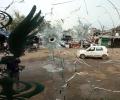
People along the Line of Control and International Border in the Jammu region continue to live under the shadow of death, with unexploded mortar shells fired by Pakistani troops still embedded in farmlands and residential areas even though hostilities have stopped for nearly a week. IMAGE: Kindly note that this image has been posted for representational purposes only. Photograph: / Rediff.com Despite the May 10 understanding between India and Pakistan, locals describe the border areas as a 'death trap'. Sixty-two-year-old Balvinder Singh, who returned to his home in Pargwal sector on May 14, recounted a narrow escape. "Two shells exploded in our compound, damaging our house. Three more landed on our farmland. We were terrified and told our family to stay away from the fields until the Army could help," Singh told PTI. Army engineers later came to the village and safely defused the unexploded shells, bringing a temporary sense of relief. "Fear is writ large on the faces of people to these death traps in border hamlets", he said. Scenes of destruction are evident rooftops torn apart, broken houses, windows punctured by shrapnel, and carcasses of cattle lying in pools of blood. The acrid smell of gunpowder still lingers in the air. Sardar Gurmeet Singh faced a similar ordeal. His family could not re-enter their home as a live mortar shell had sunk into the compound in a village close to the International Border. "The army's bomb disposal squad removed it after four days, allowing us to finally enter, back home," he said. Indian Army engineers have launched a sweeping clearance operation across border districts, defusing over 80 unexploded shells in the past five days -- including 6 in Pargwal, 19 in Rajouri, 42 in Poonch, and 12 along the IB. "These shells, mostly 120 mm calibre, have a range of 15 to 30 km and pose a serious threat to both civilian and military targets," an Army officer said. "Many of them were fired by Pakistan during recent hostilities." On May 7, the Indian Army launched Operation Sindoor, conducting precision strikes on nine terror hubs in Pakistan and Pakistan-occupied Jammu and Kashmir (PoJK) in response to the April 22 terror attack in Pahalgam that killed 26 people, most of them tourists. The subsequent retaliation by Pakistan pushed the region to the brink of war. From 7 to 10 of May, 27 civilians were killed and over 70 injured in Pakistani shelling in the Jammu region. Farid Din Gujjar, a resident near the border, expressed fear about returning to his fields. "Several shells created deep craters in our paddy land. We cannot resume work until all unexploded ordnance is cleared. It's a death trap," he said. Army units, in coordination with Jammu and Kashmir Police, have evacuated high-risk zones and issued stern warnings to residents not to touch any suspicious objects or unexploded shells. In one major operation, 42 live shells were safely destroyed in the Poonch villages of Jhullas, Salotri, Dharati and Salani. "All safety protocols were followed. The shells posed a serious danger to local lives," an Army spokesperson said, calling the effort a 'continued commitment to protect civilians and restore normalcy'. Poonch saw the vast majority of deaths due to shelling. Security officials said that Pakistan used a mix of mortar shells, armed drones, and missiles during the shelling spree, specifically targeting civilian habitations and border towns in Jammu, Samba, Kathua, Rajouri, and Poonch. As clearance operations continue, the border residents are slowly returning to their homes, but with caution, fear, and lingering uncertainty about shelling that may yet happen in the future.

The Tridents squadron which is now also known as the "Defender of the North" has replaced the MiG-21 squadron at the Srinagar air base which has traditionally been responsible for taking care of the threat from Pakistan.

The collective West has always opposed strong leaders and economic development in India, asserts Colonel Anil A Athale (retd).
